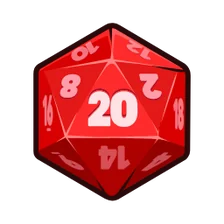
A d20 is a twenty-sided (icosahedron) die that gives a result from 1 to 20. Each result has a 5% chance and the average is 10.5. It is the core die for attack rolls, ability checks and saving throws in Dungeons & Dragons.
Quick facts
- Shape
- Regular icosahedron (Platonic solid)
- Result range
- 1 – 20
- Average
- 10.5
- Chance of a natural 20
- 1/20 = 5%
- Natural 20 with advantage
- 1 − (19/20)² = 9.75%
- Typical use
- D&D and Pathfinder attacks, checks and saves
How do I roll with advantage or disadvantage?
In D&D 5th edition, with advantage you roll two d20 and keep the higher; with disadvantage you keep the lower. Choose 2 dice and press “Roll Dice” — both results appear side by side.
Advantage raises the average to about 13.82 and disadvantage lowers it to about 7.18. The chance of a natural 20 rises from 5% to 9.75% with advantage.
Natural 20 and natural 1
When the die itself shows 20 on an attack roll it is a “natural 20”, a critical hit; a natural 1 is a miss regardless of bonuses. Zar Salla calls out 20s and 1s on the d20.
Is Zar Salla a fair dice roller?
Yes. Results come from your browser’s cryptographic random number generator (Web Crypto API, crypto.getRandomValues), and rejection sampling gives every face exactly the same probability. Nothing is sent to a server, nothing is decided in advance and no roll depends on the previous one.
Just like real dice, short streaks of the same number are normal. As you roll more, each face’s share gets closer to the expected value — you can watch this yourself in the “Stats” tab.
How many d20 do you want to roll?
Frequently asked questions
What are the odds of rolling a 20 on a d20?
1/20 = 5%. With advantage (roll two, keep the higher) it rises to 9.75%.
What is the average roll of a d20?
(1+…+20)/20 = 10.5.
Can I roll two d20 for advantage?
Yes. Choose 2 dice; both d20 roll together so the higher or lower is easy to read.
Which games use a d20?
Dungeons & Dragons, Pathfinder and every d20 System game use it as the core die.
Last updated: